
bonus deposit 100% up to
€500 + 200 free spin
€500 + 200 free spin
Home → Blackjack
Blackjack at LUCKY SPINS CASINO: Variants, Rules and Payouts
Even Money only possible with Dealer Ace
The Even Money option appears strictly when the dealer shows an Ace, allowing players to secure a 1:1 payout immediately rather than risking a push. This specific rule applies only in the Blackjack Insurance / Versicherung variant which utilizes between 6 and 8 decks for the shoe construction.
Accepting this offer mathematically mirrors taking insurance on a standard hand, effectively locking in a return that ignores the potential for a natural blackjack payout. The decision aligns with basic strategy recommendations that advise against insurance unless card counting indicates a True Count of +3 or higher.
Declining the offer preserves the opportunity to win the standard 3:2 bonus if the dealer does not hold a ten-value card in the hole. This choice yields a higher expected value over time compared to the guaranteed but lower immediate settlement provided by the even money mechanism.
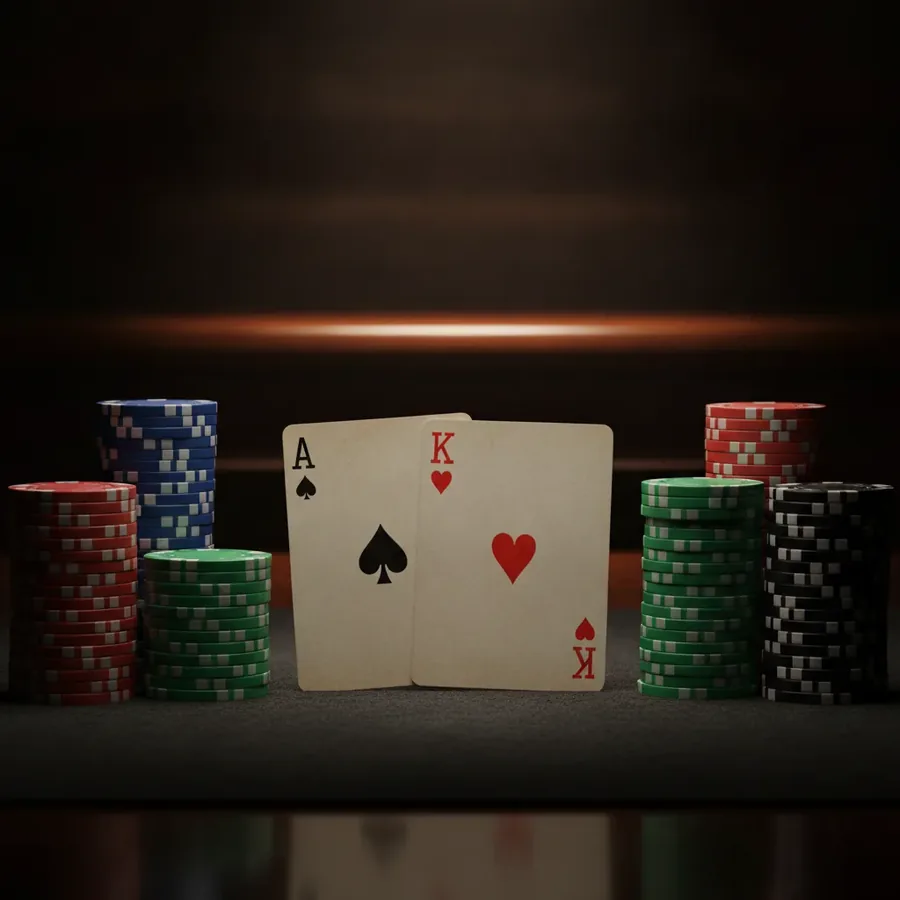
Insurance vs Even Money on Own Blackjack
Taking insurance on a player blackjack converts the potential 3:2 win into a flat 1:1 outcome, whereas declining it maintains the original 3:2 payout structure. In the Liberal Vegas Strip game, this distinction is critical because the rules allow for the highest RTP of 99.72% among the listed variants.
The house edge for insurance stands at 7.47%, meaning the bet loses value significantly faster than the main game action which carries a mere 0.28% disadvantage. Players who consistently take even money are essentially paying a premium to eliminate variance while sacrificing the superior mathematical expectation of the base game.
A standard $100 blackjack win pays $150 under the 3:2 rule, but accepting even money caps the profit at exactly $100 regardless of the dealer's final hand. This limitation removes the upside potential entirely, turning a high-yield event into a low-yield transaction with negative long-term returns.
Mobile version needs 1 Mbit bandwidth
Live streaming tables such as Infinite Blackjack require a minimum connection speed of 1 Mbit per second to maintain stable video transmission from the studio. This bandwidth threshold ensures that the real-time interaction with the croupier remains uninterrupted during critical betting windows.
Providers like Evolution and Playtech stream games including Quantum Blackjack Plus Live and Lightning Blackjack using high-definition feeds that consume significant data traffic. A connection slower than 1 Mbit will likely result in buffering delays that can cause players to miss auto-decisions or betting deadlines.
Users on restricted mobile networks may experience lag that disrupts the timing required for side bets like Any Pair or Hot 3 in infinite table formats. Maintaining the 1 Mbit baseline is essential for ensuring that the visual sync matches the actual game state without perceptible delay.
Card Counting at Shuffle Master Table: why it fails
Infinite Blackjack tables utilize continuous shuffling mechanisms that reset the deck composition after every single hand, rendering traditional card counting techniques completely ineffective. The randomization process prevents any accumulation of favorable cards that counters rely on to gain a statistical edge over the house.
Unlike traditional shoe games where a True Count might reach +3 to justify insurance plays, the shuffle master algorithm ensures each hand is statistically independent. This design eliminates the possibility of tracking card removal effects that are necessary for advantage play in multi-deck scenarios.
Players attempting to track the running count will find no predictive value in previous outcomes due to the immediate reshuffling protocol employed by Evolution. The theoretical advantage gained from counting is reduced to zero, making the strategy useless for improving the 99.47% RTP environment.
What Hole Card Means at a Live Table
The hole card is the face-down card dealt to the dealer that determines whether a player blackjack results in a win or a push. In live dealer formats, this card is revealed only after all players have completed their actions or surrendered their hands.
Late surrender rules allow players to forfeit half their bet before the dealer checks for a blackjack using the hole card, reducing the house edge by 0.08 percentage points. Early surrender is far more valuable at -0.6% but is extremely rare in modern live casino offerings.
If the dealer reveals a blackjack via the hole card, non-surrendered hands lose immediately unless the player also holds a natural twenty-one. This mechanic ensures that the payout structure remains consistent with the stated 3:2 or 6:5 terms depending on the specific table rules.
Blackjack variants at a glance
| Variant | Payout | House edge | Rule | Bet range |
|---|---|---|---|---|
| Blackjack Split / Double / H17 – Regel-Effekte | n.a. (Regel-Modifikatoren) | H17 +0.22 Prozentpunkte; RSA −0.08 Prozentpunkte; DAS −0.14 Prozentpunkte | Dealer Hits Soft 17 verschlechtert RTP um 0.22 Prozentpunkte; Resplit Aces verbessert um 0.08 Prozentpunkte; Double After Split verbessert um ca. 0.14 Prozentpunkte; 6 Decks statt 8 – ca. 0.02 Prozentpunkte. | Double – Einsatz ×2 mit einer Karte; Split – bis 4 Hände; Ass-Split meist mit einer Karte. |
| Blackjack Insurance / Versicherung (6–8 Decks) | 92.53% | 7.47% | Separate Nebenwette bis 50% der Hauptwette, wenn der Dealer ein Ass hat. Basisstrategie schreibt IMMER Ablehnung vor (außer Karten zählen bei True Count ≥ +3). Bei einem Deck Vorteil ≈ 5.88% | Insurance 2:1 |
| Blackjack Ein Deck, klassische Regeln, 3:2 | 99.85% | 0.15% | Weniger Decks = niedrigerer Vorteil; ein Deck gibt ca. −0.48 Prozentpunkte gegenüber 8 Decks. Oft durch 6:5 Auszahlung kompensiert. | Blackjack 3:2, Gewinn 1:1 |
| Blackjack Auszahlung 6:5 statt 3:2 (6 Decks) | 98.15% | 1.85% | Ersatz von 3:2 durch 6:5 fügt exakt +1.39 Prozentpunkte zum Vorteil des Casinos hinzu – stärker als jede andere Regeländerung. Bei $10 Einsatz zahlt Blackjack $12 statt $15. | Blackjack 6:5, Gewinn 1:1 |
| Blackjack Liberal Vegas Strip (liberale Regeln, 3:2) | 99.72% | 0.28% | Günstigste Regelkombination: S17 + DAS + Resplit + Late Surrender. Standardabweichung 1,15 | Blackjack 3:2, Gewinn 1:1 |
| Blackjack Surrender (Late Surrender) – Regel-Effekt | n.a. (Regel-Modifikator) | −0.08 Prozentpunkte | Spieler gibt Hand nach Dealer-Blackjack-Prüfung auf, verliert die Hälfte des Einsatzes. Verbessert RTP um ca. 0.08 Prozentpunkte. Early Surrender ist wesentlich wertvoller (bis −0.6 Prozentpunkte), aber extrem selten. | Rückzahlung 50% des Einsatzes |
Side Bet Every Round: Budget Lasts 30 Rounds
The Infinite Blackjack table by Evolution accepts bets from 1 to 5,000 EUR and supports four side bets including Any Pair and Bust It. This structure allows players to engage with multiple wagering options during every single dealt round without restriction. The maximum limit of 5,000 EUR applies to the total stake across all active positions at the virtual table.
Quantum Blackjack Plus Live by Playtech offers a distinct approach with Quantum Multipliers reaching up to 1,000x on specific three-card combinations totaling 21 points. These multipliers apply exclusively to winning hands rather than altering the base game payout structure for standard wins. Players must balance their primary blackjack stakes against these high-variance side opportunities to manage their bankroll effectively.
Lightning Blackjack by Evolution provides Lightning Multipliers capped at 25x on won hands, which is lower than the Quantum variant but still significant. The betting range for this specific title spans from 1 to 2,500 EUR, offering a slightly more accessible entry point for moderate budgets. Understanding these multiplier caps helps in calculating potential returns before placing any additional wagers on the side markets.
When does the table max bet apply?
Infinite Blackjack operates with unlimited seats at the table, meaning the 5,000 EUR limit applies per player rather than as a global cap for the entire room. Each participant can independently wager up to this maximum amount simultaneously with other players who are also hitting the ceiling. This setup ensures that high rollers do not exceed their individual risk parameters regardless of how many others are playing.
Quantum Blackjack Plus Live shares the identical 5,000 EUR maximum bet limit per player, maintaining consistency with the Infinite variant regarding financial boundaries. The application of this limit is strict for every hand dealt, ensuring compliance with the platform's risk management protocols for both main and side bets. Players cannot exceed this threshold even if they wish to place larger stakes on favorable quantum multiplier outcomes.
Lightning Blackjack enforces a lower maximum bet of 2,500 EUR per player, which is exactly half the limit found in the other two live dealer titles. This reduction reflects the different volatility profile associated with the 25x lightning multipliers compared to the higher quantum payouts. Adhering to this specific cap is crucial for accurate budget planning when switching between Evolution and Playtech live streams.
Bonus 100 EUR with 10 percent credit
Table games contribute only 10% toward the wagering requirements of the 300% welcome bonus up to 2,000 EUR plus 100 free spins offered by the casino. This low contribution rate means that every 100 EUR wagered on blackjack tables counts as just 10 EUR toward clearing the bonus conditions. Players must therefore generate significantly higher turnover on slots to offset the slow progress made on live dealer tables.
The house edge on standard infinite blackjack variants like Infinite Blackjack sits at 99.47% RTP, implying a 0.53% advantage for the house under optimal play. When combined with the 10% contribution rule, the effective cost of meeting wagering requirements through these games becomes substantially higher than slot play. This mathematical reality forces players to rely heavily on the 100% contributing slot games to unlock withdrawable funds.
Insurance bets in blackjack carry a much higher house edge of 7.47%, making them particularly inefficient for clearing bonus requirements due to the 10% credit rate. Placing insurance on losing hands or neutral situations accelerates the depletion of the bonus balance without making meaningful progress toward release. Strategic avoidance of these side bets is essential for anyone attempting to convert the welcome offer into cash via table games.
How long do 100 EUR last at a 1 EUR table?
At a 1 EUR minimum bet on Infinite Blackjack, a 100 EUR bankroll allows for approximately 100 hands before complete depletion assuming no wins occur. This linear projection ignores the impact of variance, where actual session length will fluctuate significantly based on win and loss streaks. Players should expect shorter sessions due to the natural volatility inherent in card distribution over a large number of deals.
Blackjack Surrender rules can extend the longevity of a small bankroll by allowing players to forfeit half their stake instead of losing it entirely on poor hands. This mechanic reduces the average loss per hand slightly, potentially adding several extra rounds to a 100 EUR session at the 1 EUR limit. However, the benefit is marginal compared to the dominant factor of overall game speed and hit frequency.
Double Down after Split (DAS) capabilities further influence session duration by increasing the potential return on split pairs, thereby preserving capital longer. Tables like Infinite Blackjack support DAS, allowing players to double down on re-split hands for added value on each invested euro. Utilizing this feature optimally is critical for maximizing the utility of a restricted 100 EUR budget over time.
Double Down after Split: which tables allow it
Infinite Blackjack by Evolution explicitly supports Double Down after Split (DAS), a rule that improves the player's expected return compared to restricted doubling options. This feature allows players to double their initial wager on any hand resulting from a split, provided they receive only one additional card. Such flexibility is vital for optimizing strategy when dealing with pairs like 8s or Aces against dealer upcards.
Quantum Blackjack Plus Live also permits Double Down after Split, aligning its core mechanics with industry standards for favorable blackjack conditions. The presence of this rule enhances the viability of splitting strategies, particularly when facing weak dealer upcards where doubling down yields positive expected value. Players leveraging DAS can mitigate losses during unfavorable splits by capitalizing on subsequent strong hands.
Lightning Blackjack includes Double Down after Split functionality, ensuring that the strategic depth remains consistent with the other Evolution live dealer offerings. This rule applies alongside the standard doubling options on initial two-card hands, providing comprehensive control over bet sizing throughout the hand development. Access to DAS is a key determinant for serious players evaluating the mathematical fairness of different live blackjack variants.
Soft 17: Dealer Hits or Stands
The dealer hitting on soft 17 adds exactly 0.22 percentage points to the house edge compared to standing rules in standard blackjack variants. This specific rule modifier significantly increases the casino's average retained portion of wagers over the long term for players using basic strategy. Consequently, bettors face a higher mathematical disadvantage when playing tables that enforce this hitting requirement on the dealer's hand.
Resplitting aces improves the player return by approximately 0.08 percentage points, partially offsetting the negative impact of other restrictive table conditions. Allowing this additional split action provides more opportunities to maximize potential payouts from a single initial pair of ace cards during gameplay sessions. Players should verify if their chosen live dealer table permits this specific resplitting action before placing their initial wager amount.
Double after split rules enhance the theoretical return to player by roughly 0.14 percentage points when permitted by the game provider software. This flexibility allows gamblers to increase their exposure on strong hands created through splitting, thereby reducing the overall house advantage slightly. The combination of these rule modifiers determines the final RTP value presented in the game information panel for each specific variant.
Splitting tens costs expected value: better stand
Infinite Blackjack offered by Evolution features an unlimited number of seats at the virtual table with betting limits ranging from one to five thousand euros per round. This structure allows multiple participants to engage simultaneously while accessing side bets like Any Pair and 21+3 alongside the main blackjack action. The high limit range accommodates both casual players and high rollers seeking substantial stakes within a single shared gaming environment.
Quantum Blackjack Plus Live from Playtech introduces quantum multipliers up to 1000x on three-card combinations totaling twenty-one points for enhanced payout potential. These multipliers apply specifically to winning hands, creating volatile outcomes that deviate significantly from standard blackjack payout structures found elsewhere. Players must adapt their strategy to account for these random multiplier events when calculating expected returns on their total investment.
Lightning Blackjack by Evolution offers lightning multipliers up to 25x on winning hands, operating within a betting range of one to two thousand five hundred euros. This variant maintains a house edge of 0.46% when players adhere strictly to basic strategy guidelines provided in the help section. The presence of these special multipliers adds excitement but does not alter the fundamental mathematical expectation of the base game itself.
Stand-on-17 Rule and Its Meaning for Players
Standard six-deck games with soft seventeen standing rules yield a house edge of only 0.46% when combined with double after split permissions. This favorable condition reduces the casino's advantage significantly compared to variants where the dealer must hit on soft seventeen totals. Bettors utilizing optimal strategy can expect lower losses over time when selecting tables that enforce this specific standing rule on dealers.
Liberal Vegas Strip blackjack offers one of the most advantageous rule sets available, featuring late surrender and double after split options alongside soft seventeen standing. This combination results in a remarkably low house edge of just 0.28%, making it superior to many other standard online casino offerings. Players prioritizing minimal house advantage should seek out this specific variant whenever possible to maximize their long-term bankroll preservation.
Single deck classical rules provide an even lower house edge of 0.15% due to fewer decks dealing from the shoe during gameplay sessions. However, many operators compensate for this benefit by reducing blackjack payouts from three to two to six to five ratios instead. Gamblers must carefully evaluate whether the reduced deck count outweighs the detrimental impact of inferior payout structures on their overall returns.
Surrender rules allow players to forfeit half their bet after the dealer checks for blackjack, improving return by approximately 0.08 percentage points. Late surrender is more common than early surrender, which can improve returns by up to 0.6 percent but remains extremely rare in modern digital environments. Utilizing surrender correctly against dealer up-cards enhances strategic decision-making and minimizes unnecessary losses on weak starting hands during play.
Side Bets Increase House Edge to 5 Percent
Infinite Blackjack includes four distinct side bets: Any Pair, 21+3, Hot 3, and Bust It, each carrying substantially higher house edges than the main game. While the primary blackjack action maintains a reasonable house edge, these auxiliary wagers often push the overall cost of play above five percent. Players attracted to frequent small wins should be aware that these bets statistically drain bankrolls much faster than the core game mechanics.
Insurance represents a separate side bet paying 2:1 when the dealer holds an ace, but it carries a massive house edge of 7.47%. Basic strategy universally dictates rejecting insurance unless card counting reveals a true count greater than or equal to positive three points. Accepting this bet without proper counting skills guarantees long-term financial loss due to the unfavorable odds presented by the casino structure.
The payout structure for insurance differs significantly from standard blackjack winnings, offering double the stake back only upon dealer blackjacks occurring randomly. Since dealers achieve blackjack infrequently, the frequency of winning insurance bets fails to justify the elevated house edge inherent in this option. Rational players avoid this side bet entirely to preserve their expected value and maintain alignment with optimal strategic guidelines provided by experts.
Perfect Pairs vs 21+3 in House Edge
Blackjack Insurance carries a house edge of 7.47%, whereas standard blackjack payouts of 3:2 offer a much lower disadvantage of 0.28% in liberal variants. Comparing these figures highlights why side bets generally erode player bankrolls faster than the primary game action under identical betting conditions. Understanding this disparity helps gamblers allocate their stakes more effectively toward wagers with superior mathematical expectations over extended playing periods.
Payouts of 6:5 instead of 3:2 add exactly 1.39 percentage points to the house edge, making this change more damaging than any other single rule modification. A ten euro bet yields twelve euros instead of fifteen, directly reducing the player's return on investment regardless of skill level employed. Selecting tables with traditional 3:2 payouts remains essential for minimizing the statistical disadvantage imposed by the casino on every wager placed.
Table games contribute only ten percent toward bonus wagering requirements, while slots contribute one hundred percent, affecting how quickly bonus funds convert to withdrawable cash. This restriction limits the utility of blackjack bonuses for players aiming to clear large bonus amounts efficiently through table game play alone. Gamblers must calculate turnover requirements carefully, recognizing that blackjack contributes significantly less to meeting these conditions compared to slot machine activities.
Contact
Live - online chat
[email protected]
Banking









Providers












LUCKY SPINS Casino 2024